How to Choose a Hydraulic Actuator Factory in 2026?
Choosing a Hydraulic Actuator Factory in 2026 requires more than comparing catalog prices. Performance begins with engineering discipline, material control, and honest communication.
A polished website proves little. Ask how the factory selects steel, seals, coatings, and hydraulic fluids. Request inspection records, pressure-test reports, and dimensional tolerances for comparable actuators. Details matter. A serious manufacturer should explain its design process clearly. Its engineers should understand load cycles, stroke length, operating temperature, mounting limits, and maintenance conditions. Factory records should connect raw materials to finished products. That traceability supports reliability when a component works under heavy industrial pressure.
Experience also deserves close attention. Review completed projects in agriculture, construction, manufacturing, or mobile equipment. Ask whether the factory can provide references from customers with similar operating demands. A sample actuator can reveal machining quality, surface finish, port accuracy, and seal installation. Do not rely on brochures alone. Inspect the evidence.
A dependable supplier should support design review, prototype testing, production inspection, packaging, and after-sales service. It should identify risks before they become expensive failures. Independent certifications can add confidence, but certification alone is not proof of product quality. Verify its scope and validity. No supplier is perfect. Even experienced factories may have weak documentation or slow responses. That matters too.
This guide examines practical criteria for comparing factories, checking technical competence, evaluating quality systems, and measuring long-term value. The goal is not to find the cheapest quotation. It is to choose a capable partner that can deliver consistent hydraulic actuators, communicate openly, and improve when problems appear. That is where trust becomes measurable.
Define Your Hydraulic Actuator Requirements and Application Conditions
How to Choose a Hydraulic Actuator Factory in 2026?
Define Your Hydraulic Actuator Requirements and Application Conditions
Factory selection should begin with the machine, not a supplier’s catalogue. Define required force, stroke, speed, mounting position, duty cycle, and expected service life. For a cylinder, calculate force from pressure and effective piston area. Include friction and a safety margin. Do not guess the margin blindly.
Describe the real environment in measurable terms. Record operating temperature, fluid type, contamination level, corrosion exposure, side loading, and available installation space. A mining actuator may need heavy-duty seals and protective coatings. A food-processing application may require different materials and cleaning compatibility. ISO 4413 provides widely accepted safety and design principles for hydraulic systems. It should guide your technical specification. It does not replace application testing.
Market figures show why careful specifications matter. Grand View Research estimated the hydraulic cylinders market at about USD 14.6 billion in 2023, with projected growth through 2030. MarketsandMarkets reported different values and forecasts for the same sector. Estimates vary. That is a useful warning against choosing factories from market size alone. Ask each factory for load calculations, pressure-test records, seal data, dimensional tolerances, and fatigue-test evidence. Request drawings before approving production. Check whether testing matches your actual duty cycle, not only laboratory conditions. A common mistake is specifying maximum pressure while ignoring rod buckling, side loads, and oil temperature. Those details often decide whether an actuator lasts months or years.
Verify Factory Expertise, Production Capacity, and Manufacturing Standards
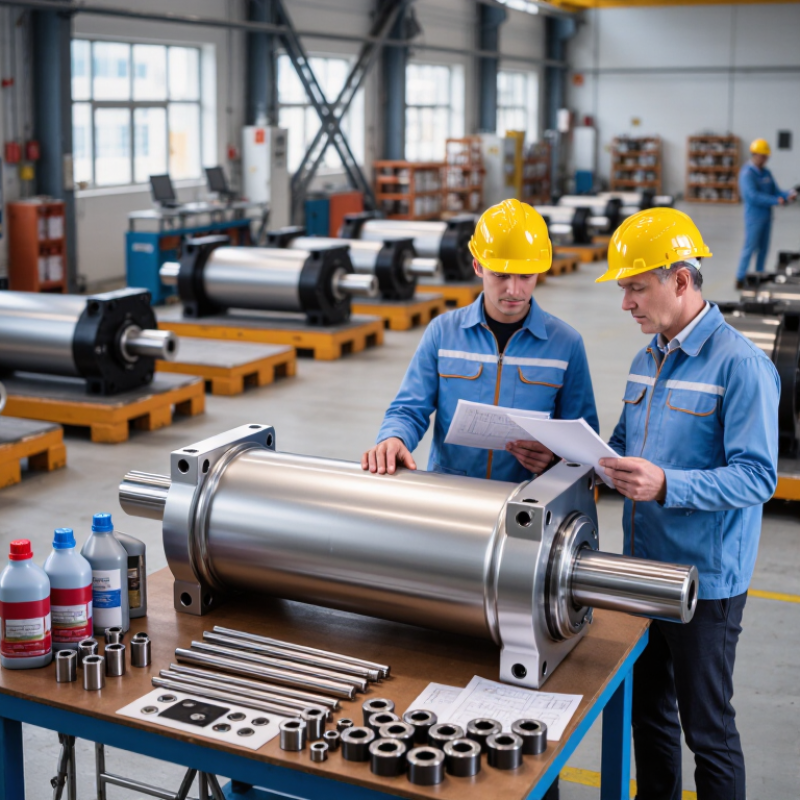
When choosing a hydraulic actuator factory in 2026, verify expertise beyond a polished website. During factory audits, I look for engineers who can explain load calculations, seal selection, rod coating, and failure analysis clearly. Ask for anonymized test records, not only product photographs. A capable team should discuss pressure testing, fatigue cycles, dimensional control, and real application risks.
Production capacity also needs measurable evidence. Check monthly output, machine utilization, available capacity, bottlenecks, and backup processes. A factory may claim fast delivery while relying on one aging machining center. That is a warning. Review calibration records, inspection reports, traceability labels, and actual lead-time data.
The ISO Survey 2023 recorded 1,265,216 ISO 9001 certificates worldwide, but certification alone does not prove actuator quality. It confirms a management system, not every production result.
Manufacturing standards should match the application. Ask how the factory applies ISO 4413 principles for hydraulic safety and ISO 6020/2 or ISO 6022 dimensions where relevant. Request material certificates and pressure-test procedures. Independent laboratory testing adds useful authority. Still, documents can become outdated. Inspect the workshop, test bench, welding area, and final inspection station yourself. A small inconsistency in surface finish or cleanliness may become a costly field failure. Reliability is built through repeated evidence, not confident promises.
Evaluate Materials, Design Quality, Testing, and Product Customization
How to Choose a Hydraulic Actuator Factory in 2026?
Material quality shapes actuator life. Ask for certificates covering steel grades, seals, coatings, and heat treatment. A reliable factory should explain material choices for pressure, temperature, corrosion, and repeated movement. Inspect machined surfaces, welds, and rod finish. Small scratches can become serious leakage paths. In my experience, a polished catalog is not proof of consistent production. Request sample inspection records and traceability from raw material to final assembly.
Design quality deserves practical attention. Check load calculations, mounting dimensions, stroke accuracy, cushioning, and seal selection. The factory should provide drawings that clearly show tolerances and connection details. Testing must include pressure holding, leakage checks, cycle testing, and visual inspection. Ask for test conditions and measurable acceptance criteria. Photographs help, but complete reports are stronger evidence. Still, no factory gets every detail right. Their response to design changes often reveals more than their sales presentation.
Tips: Visit the production area if possible. Observe cleanliness, calibration labels, and work instructions. Ask how rejected parts are controlled. Discuss customization before ordering, including stroke length, mounting style, sensors, coatings, and delivery limits. A capable engineering team should identify risks, not simply accept every request. Share your operating data, but verify their recommendations with an independent engineer when the application is critical. That extra review may expose an assumption everyone missed.
Compare Certifications, Technical Support, Delivery Terms, and Pricing
Choosing a hydraulic actuator factory in 2026 requires more than comparing unit prices. Certifications are the first filter. Check ISO 9001 scope, material traceability, pressure-test records, and destination-specific compliance. The ISO Survey 2023 reported more than 1.2 million ISO 9001 certificates worldwide, but certification alone does not prove actuator quality. Ask whether the certificate covers design, machining, assembly, and testing. Request sample inspection reports, not polished promises.
Technical support can protect a project after delivery. A capable factory should provide load calculations, mounting drawings, seal recommendations, and troubleshooting within a defined response time. Grand View Research’s 2024 hydraulic equipment report forecasts continued market growth through 2030, increasing pressure on factories to support customized systems. Delivery terms need equal attention. Confirm production lead time, inspection dates, packaging details, Incoterms, spare-seal availability, and warranty exclusions. A two-week promise means little without a written shipment milestone. Very little. Pricing should include freight, testing, tooling, replacement parts, and failure risk. A cheaper actuator may use acceptable materials but lack documentation or after-sales support. That risk is easy to underestimate. I would compare at least three offers using total landed cost, not the headline price. I would also challenge my own assumptions: the factory with the best certificate may not provide the fastest engineering response, and the lowest quote may occasionally be the most transparent.
Assess Supplier Reliability Through Samples, Audits, and Customer References
How to Choose a Hydraulic Actuator Factory in 2026?
A reliable factory should prove performance before receiving a large order. Request production samples made with your final materials, seals, bore size, and surface treatment. Test rated pressure, leakage, stroke accuracy, cycle life, side-load tolerance, and temperature resistance. Record every result. A sample that performs well once may still hide process variation.
Use audits to inspect reality, not only documents. Review calibration records, incoming-material controls, welding procedures, cleanliness, traceability, and final inspection data. The ISO Survey 2022 recorded about 1.26 million ISO 9001 certificates worldwide. Certification supports confidence, but it cannot replace factory evidence. MHI’s 2024 Annual Industry Report surveyed more than 1,700 supply-chain professionals, showing why visibility and resilience remain major purchasing concerns. Ask how the factory handles rejected parts, urgent replacements, and engineering changes. Weak answers matter.
Tips: Contact three recent customers. Ask about leakage after six months, delivery consistency, claim response, and batch-to-batch quality. Request permission to verify their comments independently. Check references from applications resembling yours. A polished audit can still miss a weak night shift. That is an uncomfortable gap. Use a witnessed factory acceptance test before shipment, and keep signed test records with serial numbers. Reliability is demonstrated repeatedly, not promised once.