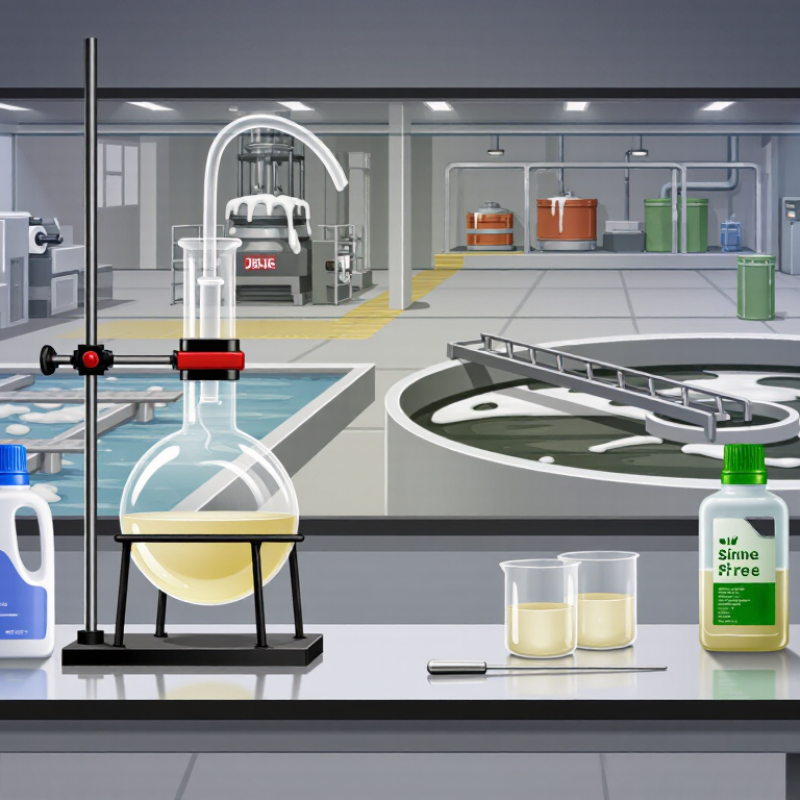
How to Choose the Right Industrial Defoamer?

Choosing the right Industrial Defoamer is not a simple product comparison. Foam behaves differently in a paper machine, wastewater tank, paint mixer, or fermentation vessel. Temperature, pH, shear, solids, and dosing equipment can change performance within minutes.

Industry reports show why this decision matters. Grand View Research identifies steady growth in the global antifoaming agents market, supported by expanding water treatment, food processing, chemicals, and manufacturing applications. MarketsandMarkets also links demand growth to stricter process control and rising production efficiency requirements. These figures describe opportunity, not guaranteed performance. A larger market does not make every formulation suitable.

Real selection begins with the process itself. A silicone-based Industrial Defoamer may collapse persistent surface foam quickly, while a silicone-free product can reduce contamination concerns in coatings or specialty chemicals. In wastewater treatment, compatibility with biological systems deserves careful testing. The U.S. EPA’s Safer Choice program provides useful guidance for evaluating ingredient safety, although certification does not replace plant trials.

Start with a small, controlled dosage test. Observe foam collapse time, re-formation, filterability, surface defects, and downstream separation. Check the result after several hours, not only after one minute. That detail matters.

Do not trust a universal solution. It rarely exists.

A practical evaluation should include supplier technical data, batch consistency, storage stability, and compliance documentation. ASTM methods or internal standard operating procedures can improve repeatability, but laboratory results may not fully represent production conditions. This is where experience becomes important. The best Industrial Defoamer is the one that controls foam without creating new problems, such as deposits, craters, odor, or unstable product quality. Mistakes happen. Good selection makes them visible early.

How to Choose the Right Industrial Defoamer?

Define the Industrial Process and Its Defoaming Requirements

How to Choose the Right Industrial Defoamer?

Define the industrial process before selecting a defoamer. Examine the raw materials, mixing speed, temperature, pH, and operating pressure. A water-based coating may need a different solution from wastewater, cement, or fermentation. Foam can form during mixing, pumping, filling, or storage. Identify the exact stage where it appears. Start with the process.

Review the foam’s behavior, not only its volume. Persistent foam often points to surfactants, proteins, suspended solids, or trapped air. Check whether the defoamer must remain effective under heat, shear, or changing pH. Compatibility is equally important. An unsuitable product may cause surface defects, cloudiness, deposits, or filtration problems. In my experience, a small laboratory test can reveal these risks early. However, laboratory conditions rarely copy full production perfectly. That limitation deserves honest attention.

Tips: Collect samples during real production, not only from storage tanks. Test several dosages around the expected working range. Watch foam collapse time, re-formation, appearance, and downstream performance. Record temperature and agitation during every trial. Small trials matter. Ask operators what changes between shifts. Their observations often reveal foam triggers that instruments miss. I once focused too heavily on foam height and overlooked a slow deposit forming on equipment walls. That mistake reinforced a practical rule: judge defoaming performance by the whole process, not one visual result.

Identify the Main Defoamer Types and Their Compatibility

Choosing the right industrial defoamer starts with identifying the foam source and the process chemistry. Foam may come from surfactants, proteins, air entrainment, or high-speed mixing. The main defoamer types include silicone-based, mineral-oil, vegetable-oil, and water-based products. Silicone defoamers usually provide strong knockdown at low dosage. Mineral-oil types often suit coatings, wastewater, and adhesive processes. Vegetable-oil options can support applications where a more renewable raw material is preferred. Water-based defoamers are easier to disperse in many aqueous systems.

Compatibility matters as much as foam control. A defoamer can reduce foam but cause craters, surface defects, poor gloss, or filtration problems. In water-based coatings, test dispersion, viscosity, and surface appearance after drying. In fermentation or food-related processing, check regulatory suitability and possible taste or odor transfer. For highly alkaline systems, evaluate stability over time, not only after immediate addition. Small differences matter.

Run a controlled trial.

Add the defoamer at several dosages, such as 0.02%, 0.05%, and 0.10%. Observe foam height, collapse speed, clarity, and re-foaming during agitation. I have found that overdosing can create new defects while leaving foam control unchanged. This is easy to miss in a short laboratory test. Keep the temperature, mixing speed, and batch order consistent. Review the result after storage, because compatibility may change overnight. No single type fits every process.

Compare Performance, Safety, Cost, and Environmental Factors

Choosing an industrial defoamer requires more than watching foam disappear. Compare knockdown speed, persistence, dosage, and process compatibility. Measure results under real temperature, pH, shear, and mixing conditions. The IEA’s Energy Efficiency 2023 report estimates that industry uses about 37% of global final energy. Efficient foam control can therefore reduce recirculation, cleaning, and production losses.

Safety starts with the SDS, not promotional language. Check GHS classification, flash point, VOC content, worker exposure, and aquatic toxicity. ECHA’s REACH framework requires registered substances to carry hazard information. Ask suppliers for test methods and current data. “Eco-friendly” is too vague. Test COD, BOD, biodegradation, and membrane compatibility when wastewater is involved. A lab test can still mislead. Temperature changes everything. Plant trials remain necessary.

Cost should be calculated per treated tonne, not per container. Include dosage, downtime, cleaning, disposal, and wastewater treatment. The World Bank’s What a Waste 2.0 report projects global waste to rise from 2.01 billion tonnes in 2016 to 3.40 billion tonnes by 2050. That figure covers municipal waste, not industrial streams, so the comparison is imperfect. Still, it supports closer scrutiny of persistent residues. Sometimes the lowest-cost defoamer wins the foam test but increases filter fouling later. Record performance over several production cycles, then question the result before approving long-term use.

Test Candidate Defoamers Under Real Operating Conditions

How to Choose the Right Industrial Defoamer?

Test Candidate Defoamers Under Real Operating Conditions

A defoamer that performs well in a beaker may fail inside a working process. I have seen this happen when plant temperature, agitation, and material loading changed together. Test candidates on the actual production line whenever possible. Record foam height, collapse time, dosage, and product quality at each trial point. Keep the process stable before comparing results. Otherwise, the data may describe process variation, not defoamer performance.

Use a small, controlled dosage range rather than adding excess material. Check performance during start-up, peak production, cleaning cycles, and shutdown. These stages often create different foam conditions. Measure temperature, pH, viscosity, shear rate, and residence time. Also inspect filters, spray nozzles, heat exchangers, and downstream surfaces for deposits or carryover. A quick visual check is useful, but it is not enough.

Repeat the trial under different operating loads. One successful shift does not prove long-term reliability. Watch for foam returning several minutes after treatment. That delay can reveal poor dispersion or limited persistence. Keep detailed records, including operator observations and unexpected changes. Some results will be disappointing. That is valuable evidence, not wasted effort. A candidate may control foam strongly while harming appearance, coating quality, or wastewater performance. Review those trade-offs with process and quality teams before approval. Sampling errors can also distort conclusions, so label containers carefully and test them promptly.

How to Choose the Right Industrial Defoamer?

Test candidate defoamers under real operating conditions

Foam height was measured five minutes after high-shear mixing at 800 rpm. Testing was performed at three representative process temperatures. Lower foam height indicates better defoaming performance, while consistent results across temperatures indicate stronger operating stability.

Select the Product and Establish a Practical Dosage Plan

How to Choose the Right Industrial Defoamer?

Selecting an industrial defoamer starts with the process, not the product label. Identify the liquid’s temperature, pH, viscosity, solids, and mixing speed. A defoamer that works in wastewater may fail in coatings or adhesives. I have found that small laboratory tests prevent expensive production mistakes. Use a representative sample, including actual contaminants and operating conditions. Test several candidates at low, medium, and high concentrations. Record knockdown speed, foam return, surface defects, and filtration behavior.

Tips: Begin with the lowest effective dosage. A practical starting range may be 0.01% to 0.10%, but every formulation differs. Add the defoamer at the same point used in production. Check results after five minutes, one hour, and after storage. Watch for haze, craters, deposits, or reduced product stability.

Build the dosage plan around measurable results. Calculate the addition by batch weight, then convert it into a clear dosing rate for operators. Consider split dosing when foam forms during several process stages. Continuous injection can be useful, but it may hide overuse. A simple control chart can track foam height, dosage, temperature, and batch results. The first plan will probably need revision. That is normal. Recheck the dosage after raw materials, equipment, or production speed changes. Keep test records and review them with process and quality teams before expanding the plan.

How to Choose the Right Industrial Defoamer? - Select the Product and Establish a Practical Dosage Plan
Application Main Foam Condition Preferred Defoamer Type Typical Product Form Recommended Starting Dosage Maintenance Dosage Recommended Addition Point Key Selection and Control Criteria
Wastewater Treatment Persistent foam caused by surfactants, biological activity, aeration, or high organic loading. Silicone emulsion for rapid knockdown; mineral-oil or polyether defoamer where silicone transfer must be minimized. Water-dispersible emulsion or liquid concentrate. 10–100 ppm 5–50 ppm Foam-prone tank, aeration basin inlet, or recirculation line. Check oxygen-transfer impact, biological compatibility, discharge requirements, and dispersion in the process water.
Water-Based Paints and Coatings Microfoam and surface foam generated during high-speed dispersion, pumping, filling, or tinting. Silicone-free polyether or polymeric defoamer for good recoating and surface appearance; silicone-based products for difficult surface foam. Low-viscosity liquid or water-compatible emulsion. 0.05–0.50% on total formulation 0.02–0.20% Split addition: part during grind or let-down, with a small post-addition if needed. Evaluate gloss, craters, recoatability, color acceptance, storage stability, and compatibility with the binder and pigment package.
Adhesives and Sealants Entrained air and foam from mixing, vacuum release, filling, or reactive components. Polyether-modified or silicone-polyether defoamer selected for the adhesive chemistry. Concentrated liquid with controlled compatibility. 0.05–0.50% on total formulation 0.02–0.20% Add during mixing after wetting of fillers; use a final polishing addition only when necessary. Confirm bond strength, cure speed, viscosity, surface wetting, transparency, and long-term storage stability.
Pulp and Paper Foam in stock preparation, white water, coating, sizing, or wastewater systems. Mineral-oil, fatty-alcohol, or silicone-based defoamer according to paper grade and downstream coating needs. Water-dispersible liquid or emulsion. 20–300 ppm 10–150 ppm High-shear circulation points, approach flow, white-water loop, or foam collection zone. Monitor sheet defects, deposits, sizing response, drainage, formation, and impact on coating or printing performance.
Textile Processing Foam during scouring, bleaching, dyeing, washing, or high-speed jet and overflow processing. Low-yellowing silicone emulsion or silicone-free polyether defoamer compatible with dyes and auxiliaries. Water-dilutable emulsion or self-dispersing liquid. 10–200 ppm 5–100 ppm Add to the bath before the foam peak or meter into the circulation line. Check shade consistency, absorbency, whiteness, residual spots, bath stability, and compatibility with wetting agents.
Metalworking Fluids Foam caused by tramp oil, surfactants, high-pressure circulation, or soft make-up water. Silicone-free polymeric defoamer or low-foam polyether; use silicone only after confirming surface and coating requirements. Water-soluble or water-dispersible liquid. 50–500 ppm 25–250 ppm Add to the sump near the return flow or at the highest foam-generation point. Verify corrosion protection, lubricity, emulsion stability, tool cleanliness, residue, and compatibility with filtration systems.
Fermentation and Bioprocessing Foam generated by proteins, nutrients, cell growth, aeration, and agitation. Food- or process-compatible silicone emulsion, polyether, or vegetable-oil-based defoamer, subject to regulatory requirements. Sterilizable emulsion or qualified liquid concentrate. 10–200 ppm 5–100 ppm Use controlled pulse additions or an automated foam-probe dosing loop. Confirm sterility, cell viability, oxygen transfer, downstream filtration, extraction behavior, and applicable regulatory status.
Chemical Manufacturing Foam from reaction gases, surfactants, solvents, agitation, or gas-liquid transfer. Select silicone, polyether, mineral-oil, or specialty polymer defoamer based on solvent polarity, temperature, and product purity. Solvent-compatible liquid or water-dispersible concentrate. 20–500 ppm 10–250 ppm Add upstream of the agitator, gas inlet, recirculation pump, or other high-shear zone. Test chemical stability, flash point, phase separation, filtration, distillation behavior, contamination risk, and final-product specifications.
Dosage guidance: ppm means parts of commercial defoamer per million parts of process material by mass; percentages are based on total formulation mass. Start at the low end, run a controlled laboratory or pilot trial, and increase in small steps only when foam remains unacceptable. Always confirm performance under actual temperature, pH, shear, residence time, and downstream processing conditions.

Cart Summary

Subtotal: $0