What Is PTFE Fuel Hose and What Is It Used For?
Fuel hose looks simple. Yet its materials and construction affect how it handles heat, pressure, vibration, and fuel exposure. Ptfe Fuel Hose uses a polytetrafluoroethylene liner, often supported by a braided outer layer. This design can provide broad chemical resistance and tolerate higher temperatures than many conventional rubber hoses. Exact performance depends on the hose specification, fittings, and installation.
The liner’s smooth interior can help fuel flow and resist residue buildup, while the braid adds strength and protection. But a braided hose is not automatically suitable for every vehicle or fuel system. Pressure ratings, temperature limits, fuel compatibility, bend radius, and connection type all matter. Check the manufacturer’s data before selecting or installing one. That detail is easy to overlook.
You may find PTFE fuel hose in performance vehicles, motorsport applications, custom builds, and some industrial fuel systems. It can be useful where heat, packaging constraints, or fuel exposure make ordinary hose less suitable. For example, a line routed near a hot engine component needs careful routing and proper protection, even when the hose itself has a high temperature rating. The surrounding fittings and nearby materials also have limits.
This guide explains what PTFE fuel hose is, how its construction works, and where it is commonly used. It also considers practical trade-offs, because PTFE hose can require compatible fittings and more careful assembly. The name alone does not guarantee a safe installation. Check the details.
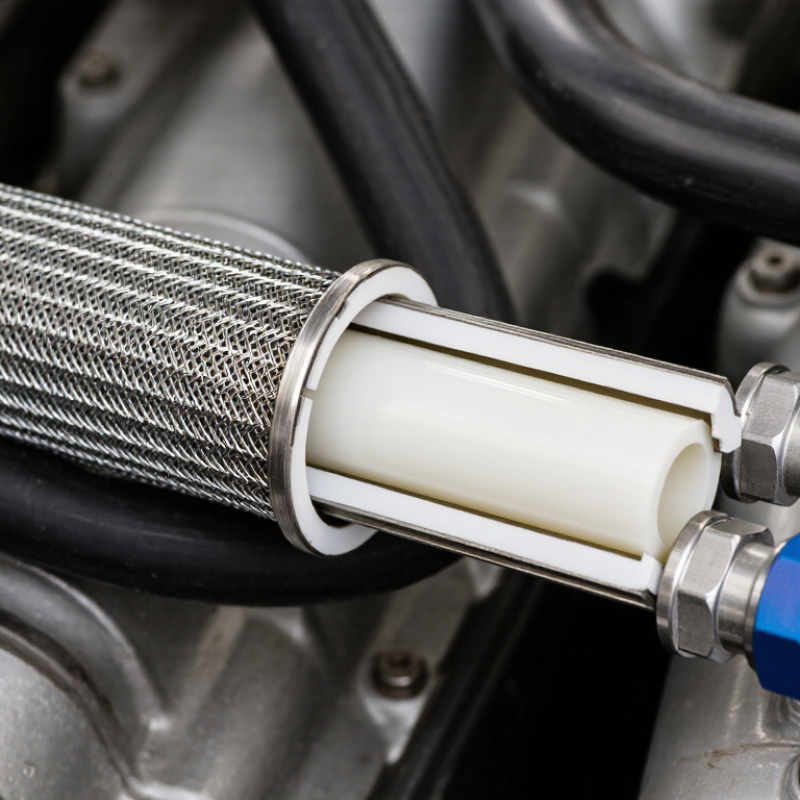
What PTFE Fuel Hose Is and How It Is Made
PTFE fuel hose uses a polytetrafluoroethylene inner tube to carry fuel. The liner resists many chemicals and has a smooth bore, which helps reduce deposits. Manufacturers may add a stainless-steel braid for pressure support and abrasion resistance. Some designs also use an outer protective cover. The exact construction varies, so appearance alone cannot confirm a hose’s pressure or fuel compatibility.
Production commonly starts with PTFE resin powder. The resin is formed around a mandrel through extrusion, then heated to fuse its particles into a continuous liner. The National Institute of Standards and Technology lists PTFE’s melting point at about 327°C. That figure describes the material, not a safe hose operating temperature. After cooling, makers may braid metal strands over the liner and test the finished assembly for leaks and pressure performance.
A detail worth checking: braid can protect the tube, but it does not automatically make every assembly suitable for every fuel or engine bay. Temperature, pressure, fittings, and installation bend radius all matter. SAE J30 is an established automotive fuel-and-oil hose specification; buyers should verify whether a particular PTFE assembly has relevant test documentation, rather than assume the standard applies. The small print matters.
How PTFE Hose Differs from Conventional Fuel Hose
PTFE fuel hose uses a smooth fluoropolymer inner tube to carry fuel. It is often selected where low fuel permeation, chemical resistance, or higher temperature capability matters. Its exact limits depend on the hose assembly, fittings, and operating conditions. The outer layer may be braided for added protection, but it does not make every assembly suitable for every vehicle.
Conventional fuel hose usually has a flexible rubber or synthetic-elastomer lining. It can be easier to route around tight spaces and may suit many standard applications when its specifications match the fuel and conditions. PTFE hose is often less permeable, which can help reduce fuel vapor passing through the hose wall. It may feel stiffer, though, and needs compatible fittings and careful assembly. Fit matters. A sharp bend or poorly matched connector can cause trouble, even with a durable liner. Neither type is automatically the better choice; check pressure, temperature, fuel compatibility, and the vehicle maker’s requirements.
Tips: Measure the route before installation, and keep the hose clear of sharp edges and hot surfaces. Follow the assembly maker’s bend-radius and fitting instructions. Recheck connections for leaks after installation.
Key Properties of PTFE Fuel Hose
PTFE Fuel Hose: Key Properties
PTFE fuel hose has a smooth, chemically resistant inner tube. It can handle many fuels and additives without softening as quickly as some rubber materials. Its low-friction surface also helps fuel flow through a clean, unobstructed bore. Another useful property is low permeability, which limits fuel vapor moving through the hose wall. Not magic.
Temperature capability depends on the complete hose assembly, not just the PTFE liner. Reinforcing braid affects pressure strength, while fittings and installation affect reliability. PTFE can feel stiffer than rubber hose, so tight bends may flatten or strain it. Check the maker’s stated temperature, pressure, and bend-radius limits for the exact assembly. A conductive liner may be specified in some designs to manage static charge; plain PTFE is electrically insulating. That detail is easy to miss.
Tips: Route the hose away from sharp edges and hot surfaces. Use compatible fittings, avoid twisting the line during installation, and inspect it for abrasion or kinks. A neat-looking hose can still be under strain.
Common Applications of PTFE Fuel Hose
PTFE fuel hose is used in vehicles and equipment where fuel compatibility, temperature tolerance, and a durable inner lining matter. In performance cars, it may connect fuel pumps, rails, filters, or injectors, especially where engine-bay heat challenges ordinary hose. A short section near a hot engine can still need careful routing and secure fittings. PTFE is not a substitute for checking pressure ratings.
Marine engines are another common application. Fuel lines may pass through warm, cramped compartments, where chafe and movement deserve attention. PTFE hose also appears in motorcycles, off-road vehicles, and some small-engine systems. In industrial equipment, it can carry compatible fuels between tanks and components. The actual fluid, operating pressure, temperature, and hose construction must match the application.
A caveat matters. PTFE hose can be less flexible than rubber hose, making tight bends awkward. It may require compatible end fittings and more deliberate installation. That sounds simple. It isn’t always. Avoid twisting the hose, keep it clear of sharp edges, and inspect connections for leaks or wear. For aircraft or other safety-critical equipment, use only assemblies approved for that specific system and installed by qualified personnel.
Factors to Consider When Choosing PTFE Fuel Hose
Choosing PTFE fuel hose starts with the fluid and operating conditions, not its appearance. Confirm that the hose liner is rated for the specific fuel blend, additives, and expected temperature range. PTFE resists many fluids, but compatibility should never be assumed. Check continuous pressure and pressure spikes, especially near pumps or regulators. Leave a suitable safety margin.
Construction matters. A stainless-steel outer braid can help resist abrasion, while a protective cover may suit areas exposed to moisture or road debris. The braid does not prevent kinks. Check the minimum bend radius and route the hose away from exhaust heat, sharp edges, and moving parts.
Fit matters. Match the hose size, end fittings, and sealing method. An incorrectly assembled connection can leak even when the hose is suitable. Verify that the fittings are designed for PTFE-lined hose.
Consider installation space and future access. A route that looks tidy on paper may rub against a bracket once the engine moves. That detail is easy to miss. After fitting, check for twists, contact points, and leaks using the appropriate procedure for the vehicle. Also review the supplier’s pressure and temperature data rather than relying on a general description. The right choice depends on the full setup, not just the hose diameter.